| Sn-Ag-Cu | This alloy series is the most popular lead-free solder, characterized by a lower melting point and improved mechanical stability under increased temperature cycling pressure. The diffusion rate of lead in pure tin is higher than that of tin lead alloy, as can be seen from the comparison of mechanical properties of lead-free solder. | When using traditional flux, its wettability is not as good as traditional tin lead solder, and special flux is needed to improve its disadvantages. Copper dissolves in SnCu alloy, making it easy to generate brittle Cu6Sn5, which affects the reliability of solder joints and has high silver cost. | Solder paste products for reflow soldering |
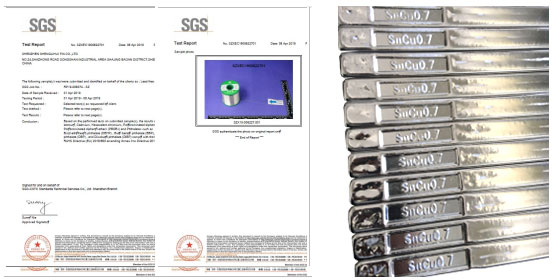
| Sn-Cu | Sn-Cu alloy is the cheapest lead-free soldering material in the wave soldering process, and it is compatible with major lead containing polished surfaces. Therefore, many companies consider it as the preferred lead-free solder, and according to Nnrtel's testing, SnCu alloy has better thermal fatigue resistance than traditional SnPb. And eutectic alloys are favored because they have a single melting point rather than a general melting point range. | It should be noted that its melting point is higher than that of SnAgCu alloy at 227 ° C, which is 1.5 times the market price of tin lead low eutectic mixtures. However, on the other hand, SnCu alloy has a high melting point (227 ° C) and poor mechanical properties, although it may not necessarily be a disadvantage in certain applications. | Wave soldering tin bar products, manual soldering iron soldering tin wire products |